
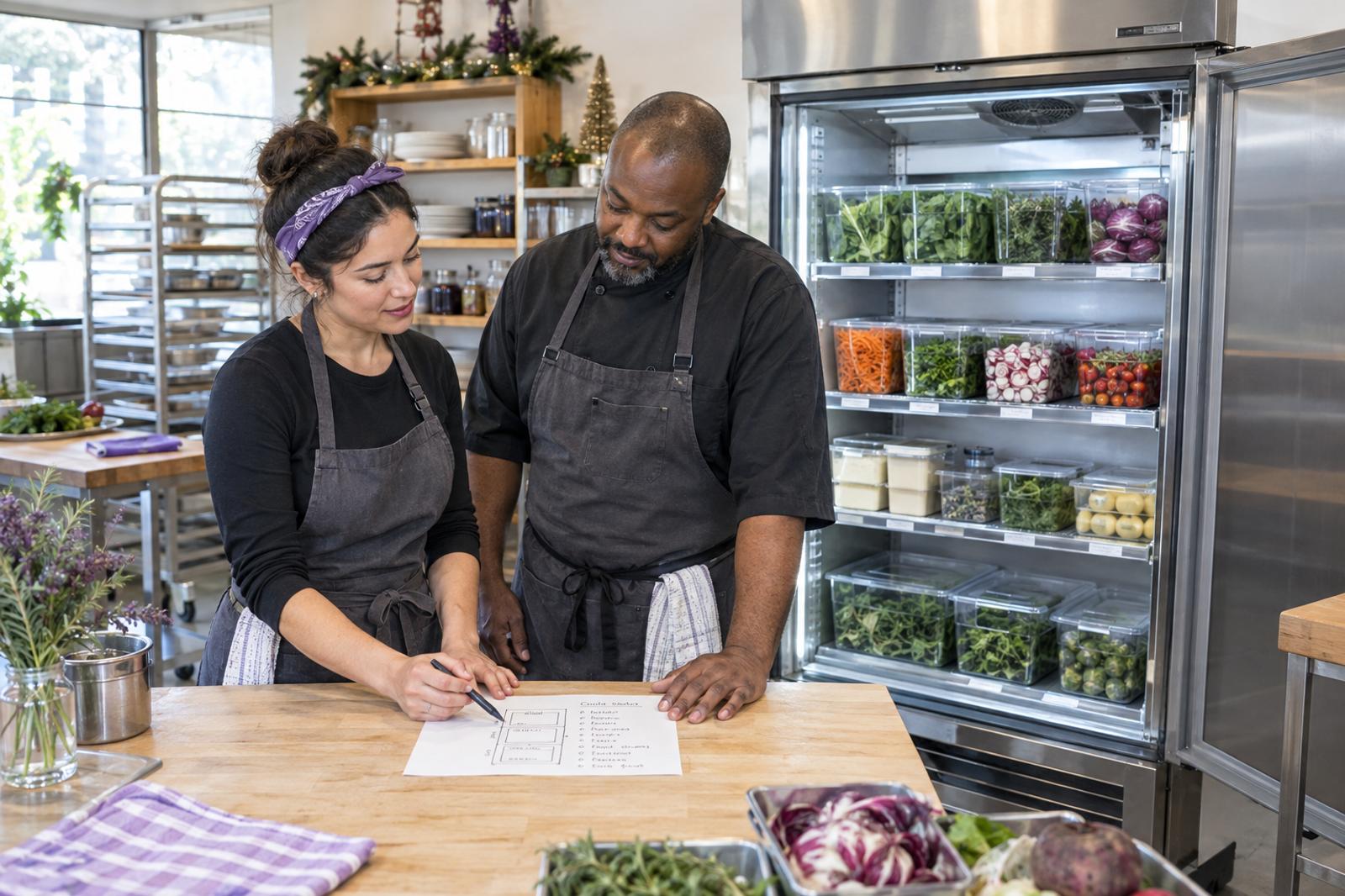
Holiday orders can turn a manageable café or catering kitchen into a cold-storage puzzle: regular stock still needs room, event ingredients arrive in waves, and prepared items may need their own protected space. The goal is not to squeeze in the largest possible delivery. It is to know what your equipment can safely hold, reserve space for the work already promised, and adjust the plan before crowded shelves force rushed decisions.
Start by mapping the space you can actually use. Walk through each refrigerator and freezer with the person responsible for food safety. Note usable shelves, drawers, racks, and designated zones, then mark areas already committed to daily stock, prepared foods, or separation requirements. Treat “capacity” as space that preserves the airflow, access, and separation your procedures require—not every inch that could physically fit another box. The FDA’s food-storage guidance cautions against overpacking refrigeration because cold air needs room to circulate; commercial operations must also follow their own applicable requirements.
Next, translate the holiday menu and confirmed orders into a cold-space list. For each ingredient or prepared item, write down the expected quantity, delivery date, storage needs from the label or supplier, intended use date, and any separation or handling instructions. Include regular stock that will still be on hand during the event. This is where a plan for holiday menus, recipes, purchases, and supplies becomes useful: a menu change can alter both what you buy and where it needs to go.
Make a simple space plan
Use a shelf map, not just a total volume estimate. Mark the locations reserved for established categories and leave the working clearances your equipment and food-safety procedures require. Keep raw ingredients, ready-to-eat items, allergens, and prepared foods separated according to your approved procedures and local rules. Label zones clearly for the team, but do not treat a shelf label as a substitute for required food identification, date marking, temperature checks, or other controls.
Illustrative example: A small caterer maps five practical shelf-equivalents for a particular week after accounting for routine stock and required separation. The holiday order would occupy six shelf-equivalents if everything arrived at once. That mismatch is a planning signal—not a reason to compress containers or block circulation. The owner asks the supplier whether the order can be split into two suitable delivery windows, checks that the later delivery still fits the prep schedule, and revises the menu quantity if a safe, workable plan cannot be confirmed. These shelf counts are invented for illustration, not a capacity standard.
Work backward from delivery and service
For each event, set a “space decision” date before the supplier’s cutoff. Confirm order quantities, delivery windows, equipment availability, and which existing stock will be used first. Ask suppliers about realistic lead times and whether split deliveries are possible; do not assume a late delivery can be accommodated just because an order was placed. If a purchase depends on customer confirmation or a deposit, make that dependency visible in the plan rather than reserving space for an unconfirmed volume as though it were certain.
Receiving day is the moment to compare the plan with reality. Assign someone to check the delivery against the order, follow the kitchen’s receiving and temperature-check procedure, record substitutions or shortages, and move accepted products promptly to their designated storage. The food delivery receiving checklist covers how to document discrepancies and update records using the quantity actually accepted. If a delivery arrives early, late, or in a larger quantity than planned, pause and resolve the space problem before putting food somewhere unsuitable.
Use a clear stop/go rule
Agree in advance on the conditions that mean “do not accept or put away this load yet.” Examples include no suitable space without blocking required airflow, a conflict with separation procedures, unavailable temperature monitoring, or an equipment concern that the person in charge cannot resolve. Follow your written policy and local requirements for assessing and rejecting product; do not leave perishable food at room temperature while the team debates what to do. Possible operational responses include arranging a supplier-approved split delivery, reducing a menu item before confirming the order, or using suitable off-site cold storage only when it is approved and the transfer and monitoring process are clear.
During the holiday period, review capacity at the start and end of each operating day. Check the equipment and food temperatures as required by your procedures, make room by using stock in the planned sequence, and update the map when quantities or event details change. Keep the person responsible for food safety informed of deviations. For U.S. businesses, the FDA describes its Food Code as a model used by regulators; jurisdictions may adopt or update provisions, so consult your local health department and current applicable code rather than assuming one national checklist covers every kitchen.
Holiday cold-space checklist
- One to two weeks before: confirm the event menu and quantities; map usable cold-storage zones; list routine stock and incoming items; check supplier cutoff dates, delivery windows, equipment condition, and local procedures.
- Before placing the order: compare planned shelf use with the space that remains after required separation and airflow; identify a decision-maker and a clear stop/go trigger; arrange split deliveries or revise quantities if the plan does not fit.
- On delivery day: check the order and product condition using your established procedure; document actual quantities, substitutions, and exceptions; put accepted items away promptly in their designated locations.
- Each operating day: review upcoming deliveries and events, perform required temperature and equipment checks, use stock in the planned sequence, and revise the map when the real inventory changes.
Keep the records useful but separate. A purchase record can show what was ordered or received, while a food-safety log and equipment checks should follow your establishment’s approved process. Ququ Food’s current overview describes menu products and recipes, recording purchases and sales, and reviewing financial views; it does not describe cooler-capacity planning or temperature monitoring. If those menu and transaction records fit your workflow, see Ququ Food—and keep physical storage and safety checks in the systems your operation requires.