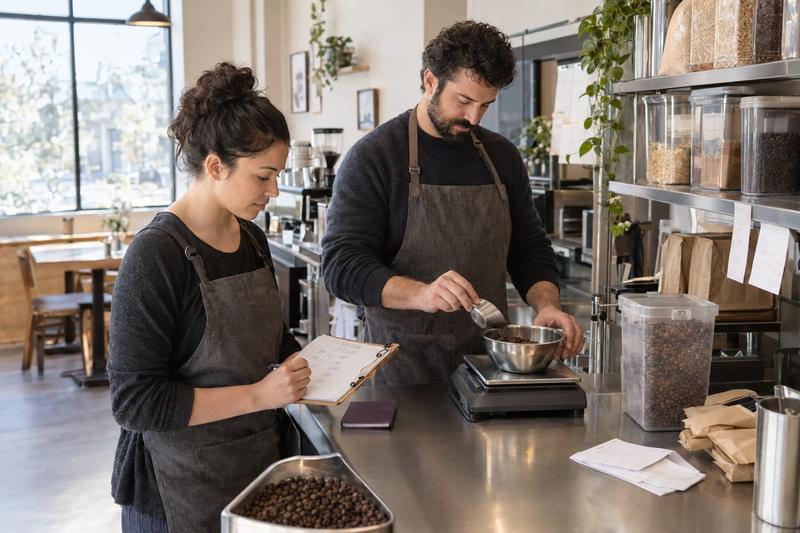

A takeaway latte may start with coffee and milk, but it leaves the counter in a cup, lid, sleeve, napkin and perhaps a bag. If your menu costing stops at ingredients, those supplies disappear from the item-level math—even though you pay for them order after order. This guide adds that missing line with invented examples, a copy-ready bill of materials and a simple re-pricing routine. Use your own invoices for decisions; the figures below are illustrative, not market prices or financial advice.
First choose a consistent cost definition
“Food cost” does not mean exactly the same thing in every dataset or accounting setup. The National Restaurant Association’s 2025 Restaurant Operations Survey defines limited-service cost of sales as food and beverage products plus paper products; its direct operating expenses category separately includes service-related items such as utensils, menus, cleaning and other supplies. The survey asks for one location’s fiscal-year 2024 (or most recent 12-month) figures. Read the survey’s definitions before comparing your ratio with a benchmark, and keep the same treatment of cups, boxes and other supplies in both your numerator and your internal reports.
For a practical menu decision, track two numbers side by side: ingredient cost per order, and ingredient-plus-disposable cost per order. You can also calculate a combined food-and-packaging percentage by dividing both costs by the item’s selling price. Label it clearly; do not compare it casually with a benchmark that may classify paper products differently. If you want the context for industry medians, the café food-cost benchmark guide explains how definitions and samples affect comparisons.
Worked example: a $4.75 takeout latte
Assume the latte’s ingredients cost $0.95: coffee, milk and any syrup. Against a $4.75 menu price, that is $0.95 ÷ $4.75 = 20.0%. Now add one cup at $0.22, lid at $0.06, sleeve at $0.05, and a stirrer-and-napkin set at $0.04. Packaging adds $0.37, so the direct ingredient-and-packaging cost is $1.32 per drink. That equals 27.8% of the $4.75 price, before labor, rent, utilities, merchant fees, delivery commissions, waste or other operating costs.
The distinction matters when a supplier’s invoice changes. If the disposable set for this latte costs $0.40 more per order than your old packaging combination, your direct cost rises by $0.40 per drink; it does not mean a menu price should automatically rise by exactly $0.40. For example, at a chosen 28% ingredient-and-packaging target, $1.72 of combined cost would imply $1.72 ÷ 0.28 = $6.14 as a mathematical menu-price starting point. That target is only an assumption for this illustration, not an industry recommendation. Check customer demand and the other costs that the simple ratio leaves out.
Worked example: a boxed lunch
Now take an invented $8.50 catering lunch: sandwich ingredients cost $1.55, side $0.70 and cookie $0.45, for $2.70 in ingredients. The paper box costs $0.34, bag $0.12, cutlery kit $0.08, napkin $0.03 and label $0.04: another $0.61. The order therefore costs $3.31 in ingredients and packaging. Ingredient-only cost is $2.70 ÷ $8.50 = 31.8%; combined cost is $3.31 ÷ $8.50 = 38.9%.
If the café chooses a 35% combined food-and-packaging target for this example, divide $3.31 by 0.35: the mathematical price is $9.46, so a menu might round to $9.50 after considering its full pricing approach. That calculation is not a complete catering quote: it excludes labor, delivery, taxes, service charges and other overhead, and it assumes the same bundle goes with every lunch. For headcount and purchasing changes, see the catering guest-count guide; for ingredient yield and recipe portions, see the recipe-cost-per-portion walkthrough.
Copy-ready to-go bill of materials
Build one list per popular takeout item or standard order bundle. For every line, record the supplier pack size, pack price, usable units per pack, cost per usable unit, units used per order and cost per order. “Usable” matters: damaged cups or a case of mixed items you cannot use evenly may make the theoretical unit price misleading.
- Latte cup: supplier pack size 1,000; pack price $220; units per pack 1,000; cost per unit $220 ÷ 1,000 = $0.22; units per order 1; cost per order $0.22.
- Lid: pack size 1,000; pack price $60; units per pack 1,000; cost per unit $0.06; units per order 1; cost per order $0.06.
- Sleeve: pack size 1,000; pack price $50; units per pack 1,000; cost per unit $0.05; units per order 1; cost per order $0.05.
- Stirrer-and-napkin set: pack size 1,000 sets; pack price $40; units per pack 1,000; cost per unit $0.04; units per order 1; cost per order $0.04.
Packaging subtotal: $0.22 + $0.06 + $0.05 + $0.04 = $0.37 per latte. Use the same fields for a lunch bundle: box, bag, cutlery kit, napkin and label, each with its own invoice pack price and quantity per order. If a menu item uses two sauce cups or a catering bundle includes multiple meals in one bag, enter the actual quantity rather than assuming one unit.
Re-price from invoices, not headlines
Set a quarterly calendar reminder, and also update a line when a supplier changes pack size, price, quality or availability. Start with the latest invoice, calculate price per usable unit, then multiply by the quantity your standard order actually uses. If you receive 1,000 cups but discard 20, the effective cost per usable cup is pack price divided by 980—not by 1,000. Keep the invoice date, supplier, unit conversion and notes on substitutions beside the calculation. A receiving routine for food and supplies can help your team capture invoice changes and discrepancies while deliveries are checked.
Then compare suppliers on the same basis: same specification, usable unit, delivered cost and order quantity. A lower case price may not be cheaper per usable cup if it contains fewer pieces, requires a different lid, causes more damage, or ties up cash and storage in a bulk order. The National Restaurant Association’s 2026 industry report says 82% of operators reported higher average food costs in 2025 than in 2024; that is context about reported food costs, not a measurement of disposable-packaging inflation. Its discussion says metal tariffs could affect packaging and equipment. Packaging Dive’s March 4, 2026 report described duties then in effect, but trade rules subsequently changed. The NRA 2026 report and the June 2 White House proclamation show why this is date- and product-specific context, not a reason to forecast your café’s costs or assume a tariff applies to every cup or container. Your current supplier invoice is the decision input.
Five small levers to test
- Standardize to fewer cup, lid and box sizes where the service still works, so you have fewer combinations to count and re-price.
- Compare bulk pricing only if you have the storage, shelf life and cash to use the stock; a lower per-piece quote can still be a poor fit.
- Review what goes into every bag by default. Offer napkins, cutlery or condiment cups according to the order and customer need rather than adding them automatically when appropriate.
- Compare two suppliers using delivered cost per usable unit and matching specifications, not just the carton total.
- If you are considering a separate packaging charge, first verify the rules and disclosure requirements for your city, state, sales channel and menu. Requirements vary; this is not legal advice.
Do not try to solve the whole margin in one surcharge or one generalized industry ratio. Re-cost the items that travel with the order, decide how you classify them, and review the resulting price alongside sales, portions, labor and delivery costs. If a price update is needed, the menu price-change wording guide offers practical ways to explain it without implying that a single supply invoice tells the whole story.
For teams using Ququ Food, the Food module’s current product page describes menu products and recipes, recording purchases and sales, and reviewing income, expenses and margin. You can record supply purchases as part of that money trail, while keeping this per-order packaging worksheet manual: do not assume the software automatically calculates packaging cost per recipe or alerts you when a supplier price changes.