
January 1 is more than a calendar rollover for businesses that sell across city or county lines, send quotes for future work, or renew software subscriptions. Local sales-tax rates change in multiple states, and California and Colorado are changing the tax treatment of some software. This guide is a practical update checklist—not a rate table or tax advice. Rate and law check: November 21, 2026. Verify each applicable state, city, county, and special-district notice again before charging customers; new notices and implementation details can change.
What is changing on January 1, 2027?
As of November 18, a specialist roundup of confirmed local rate changes listed changes across at least 12 states. Use it as an index, not as your final authority: confirm the exact rate, location boundaries, taxable items, and effective-date rule with the relevant revenue department or local jurisdiction. A few examples show why one blanket “2027 rate” update is not enough:
- Washington: Spokane city’s combined rate becomes 9.3% on January 1, reflecting new city and county local taxes. Washington’s Q1 2027 local tax notices provide the rate and location codes.
- Iowa: Ankeny’s local option sales tax adds 1%, taking the city rate from 6% to 7%; see the City of Ankeny notice.
- Wyoming: Laramie County, including Cheyenne, moves from 5% to 6%. Check the state’s current sales and use tax rate charts for the effective-date chart and the right jurisdiction.
- South Dakota: Custer, Fall River, Lawrence, Lincoln, Meade, and Pennington counties are implementing a 0.5% county gross receipts tax. The state calls it a gross receipts tax, not simply a sales-tax rate; check the Department of Revenue announcement and current jurisdiction listing.
Washington also raises the Business and Occupation (B&O) retailing rate from 0.471% to 0.5% for the classifications listed in its November 2 special notice. B&O is a business tax, not a sales-tax line to add to a customer’s receipt; eligible businesses should review their own classification and cash plan.
Two states have notable software changes. California’s SB 122 expands sales and use tax to certain digital products, including prewritten software accessed remotely, from January 1. The law has exclusions and transaction-specific rules, and the CDTFA emergency regulations page shows implementation rules in proposed rulemaking as of this check. Colorado’s HB 26-1223 generally makes computer software taxable whether delivered on a disk, download, or remote access, subject to exceptions and local-jurisdiction differences; see the state’s software guidance. Ask vendors how a subscription will be treated for your business and location rather than assuming every recurring software charge is taxable in the same way.
Colorado food businesses should also note a separate provision in HB 26-1223: qualifying restaurants, bars, caterers, food-service contractors, and mobile food vendors may be eligible for a limited state sales-tax deduction for sales in July, August, November, and December of 2027 and 2028. The cap is up to $14,000 of qualifying state net taxable sales in a specified month—not $14,000 of tax savings—and eligibility, timely filing, and local taxes still matter. Review the enacted bill and current Colorado Department of Revenue instructions before relying on it.
The December quote that turns into January work
A quote sent in December does not automatically lock in December’s tax rate. Which date controls can depend on the state’s rules and transaction type—such as when the sale occurs, when an invoice is issued, when goods are delivered, or how a contract is treated. North Dakota’s January local-tax notice, for example, says the new tax applies to contract bids submitted on or after the effective date for the listed cities. That is a useful reminder to check the specific notice, not a rule to generalize to every state. For a given project, confirm both the tax treatment and the contract wording with the relevant revenue department or a qualified adviser.
Consider an illustrative Cheyenne job with a $6,200 taxable base. At 5%, tax would be $310; at 6%, it would be $372—a $62 difference. This assumes the entire amount is taxable, the cited rates apply to the transaction, and tax is charged on top. If the signed quote clearly says “plus applicable sales tax” and the law and agreement permit the later rate, the customer may owe the changed tax. If the business promised an all-in fixed total, or the agreement allocates the risk differently, the business may need to absorb some or all of the difference. The example is arithmetic, not a conclusion about who legally owes tax on a real job.
Before revising an open quote, inspect its expiry date, acceptance status, price-includes-tax language, change terms, and any promised start or delivery date. Keep the old version, issue a clearly numbered revision, and state what changed without suggesting the customer caused it. For the mechanics, see our quote version-control guide; for the basics of presenting tax separately or inside a price, use the sales-tax and VAT quote guide.
Copy-ready wording to adapt
Quote tax line — standard estimate: “Sales tax is estimated using the information and rates available today. The amount charged will reflect the taxability, sourcing rules, and rate applicable to the sale.” Alternative, where tax is shown separately: “Quoted amount is before applicable sales tax; tax will be itemized when the transaction is completed.”
Quote tax line — date-specific, only if appropriate: “Sales tax shown uses the rate currently applicable to the stated location. If the applicable tax rate or treatment changes before the taxable sale, we will confirm any resulting adjustment before proceeding.” Do not swap in “rate on the invoice date” unless that date actually controls under the relevant jurisdiction’s rule. If you use tax-inclusive pricing, say so explicitly and have an adviser review how your terms handle a rate change.
Email for an open quote, before New Year: “Subject: January tax update for quote [number]. Hi [Name]—A local tax change may affect work scheduled after January 1. I’m checking the rule that applies to this project and will send a revised quote if the taxable amount changes. Your current scope and pre-tax price are unchanged. I’ll confirm the final tax treatment before work begins.”
Email after confirming a quote needs revision: “Subject: Revised quote [number]—tax line updated. Hi [Name]—The applicable tax rate for [location/transaction] changes on January 1. Attached is version [2] with the tax line updated from [old amount] to [new amount]; the scope and pre-tax price are unchanged. Please review the revised total and let me know if you have questions before approving.” Use only after confirming the governing rule and that your agreement allows the adjustment.
Menu or price-board footnote — tax added at checkout: “Prices are before applicable sales tax; tax is added at checkout.” Alternative, if displayed prices include tax and local requirements permit it: “Displayed prices include applicable sales tax.” Requirements for advertised or menu prices vary, so have a local adviser review the version you use. For more café and catering announcement examples, see our menu price-change wording guide.
Website checkout note — location-based calculation: “Applicable tax is calculated at checkout using your order and delivery or pickup details.” Alternative when the checkout displays an estimate: “Tax shown is an estimate and may be updated if your order details or applicable tax rules change before the sale is completed.” Coordinate the settings with your e-commerce or point-of-sale provider and test shipping, pickup, and in-person orders separately; do not assume a saved rate table updates itself correctly.
Reply to “Why did my total change?”—local rate: “The pre-tax price has not changed. The local tax applicable to this transaction changed on January 1, so the tax line is different. I’m happy to share the revised itemized total.” Alternative—tax treatment: “The updated total reflects the tax treatment applied to this item and transaction under the current rules. The item price is [amount], and the tax is shown separately as [amount].” If you cannot explain the calculation confidently, pause and verify it before replying.
Year-end checklist: finish before December 31
- Map where you sell. List store, job, delivery, pickup, and customer locations that may affect sourcing. Identify the state, county, city, special district, and any home-rule authority involved.
- Check primary notices. Confirm the effective date, full rate, taxability, location code, exemptions, and special rules on each official department page. Use secondary roundups only to find what to verify; the official state notice, such as North Dakota’s local-tax change page, is the final check.
- Review open quotes and bids. Flag January work, new bids, delivery after year-end, and quotes expiring in January. Check contract wording and who bears a lawful tax change; save a dated copy before issuing a revision.
- Update reusable materials. Review quote templates, saved products, menu PDFs, counter signs, web pages, FAQs, and customer-service scripts. Put an effective date on the revised file and remove old versions from shared folders.
- Test checkout and POS. Ask your provider how to update location rates, tax categories, exemptions, and pickup/delivery rules. Run a test for each relevant location and keep the test result with your year-end records.
- Check software and cash planning. Review January SaaS and software renewals in California and Colorado, ask vendors what they will charge and why, and add any confirmed change to your January expense plan. Put the first 2027 sales-tax filing date on your calendar. If you need a month-by-month cash view, use this 2027 budget worksheet.
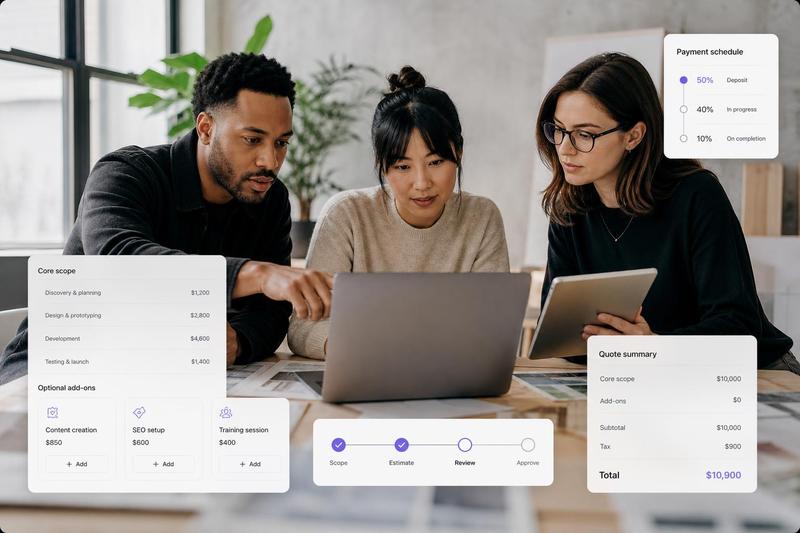
Ququ Quotes can help keep reusable products and templates, quote conditions, payment schedules, and branded PDF exports together. Its “Add to budget” option can place a quote’s payment plan in Ququ Finance as expected income; it does not look up tax rates, calculate jurisdiction-specific tax, file returns, or guarantee compliance. Learn more about Ququ Quotes.
Not tax or legal advice. The examples and notices above are a starting checklist, not a complete list of 2027 changes. Taxability, sourcing, contract treatment, menu-price disclosure, and filing requirements vary by location and transaction. Recheck the latest official guidance and consult a qualified tax professional about your facts.