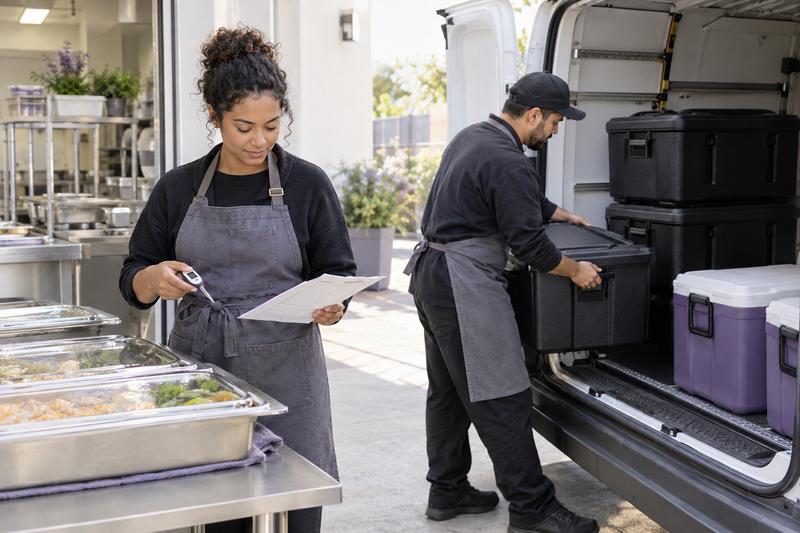

A container can look and smell fine and still be past the date your food-safety procedure allows. For a café or catering kitchen that prepares food ahead, a consistent date-marking routine helps staff see what a container is, when its holding period began, and when it must be used or discarded. It also prevents the busy-shift question, “When did we make this?” from turning into a guess.
First, check whether the rule applies
The FDA Food Code’s date-marking provision is directed at certain refrigerated, ready-to-eat time/temperature control for safety (TCS) foods held longer than 24 hours in a food establishment. It does not mean every item in a refrigerator needs the same label or that every product follows an identical timeline. Food category, preparation and packaging matter; exceptions also exist. Before adopting a rule, check the version of the food code your state or local authority has adopted and ask your regulator how it applies to your menu.
Under the FDA model provision, applicable food held at 41°F (5°C) or below is marked with the date or day by which it must be consumed on the premises, sold, or discarded, and may be held for a maximum of seven days. The preparation or opening day counts as Day 1. The FDA explains the parameters and gives examples of acceptable date-marking methods in its Food Code section 3-501.17 date-marking guidance. This is a model-code reference, not a substitute for local requirements.
Count Day 1 before you write the discard date
Use a simple calendar example to train the team. If an applicable batch is prepared on Monday and kept at 41°F or below, Monday is Day 1, Tuesday is Day 2, and Sunday is Day 7. The model rule’s maximum holding period ends at the end of Day 7; do not count seven full days after Monday. If your local code or approved procedure specifies a different method for a particular food, follow that requirement instead.
For a practical label, include the item name, the preparation date, the discard-by date, and staff initials if that helps your kitchen trace the batch. A label could read “Roasted vegetable filling — made Mon 10/19 — discard by Sun 10/25 — AB.” Those dates are illustrative; staff should calculate the actual date from the day the batch was prepared and use the format required by the local procedure. The FDA model code does not mandate one particular label format, so choose a clear method the whole team can read consistently.
Build the label into the prep routine
Make date marking part of the handoff from prep to storage, rather than a task to catch up on later. At the end of each batch, the person who prepared it writes the label, checks the item and dates, and places the container in its designated storage area. If a batch is split into multiple containers, make sure each container keeps the identifying information needed to manage it safely. Keep labels legible and attached; avoid shorthand only one employee understands.
Use a brief opening and closing walk-through as an operational check—not as a claim that the FDA requires those exact checks. Look for containers that are missing a date, hard to identify, or past their discard date, and verify that cold storage is being managed under your food-safety plan. A check sheet can have four columns: item, label readable, date within allowed period, and action taken. Assign one person per shift to record exceptions so the same questionable container is not repeatedly passed over.
When a label is missing or unclear
Do not estimate a preparation date from memory, appearance, or the position of a container on a shelf. Set the item aside so it is not served while the responsible person checks approved batch records or asks the person who prepared it. Follow your written procedure and local rules to decide the next safe action; if the history cannot be established, do not assume the food is still acceptable. Record the resolution and use it as a coaching moment to fix the point where the label step was missed.
Date marking works alongside—not instead of—good receiving, storage, and ingredient-change controls. When food arrives, check it and store it using a consistent routine, as described in this food delivery receiving checklist. If a recipe or ingredient changes, keep allergen and cross-contact review separate from date marking; this café allergen change-control checklist covers that different responsibility.
A quick shift checklist
- Confirm which menu items and processes are covered by the locally adopted rule.
- Label applicable batches as soon as they are prepared or opened, using a format the team understands.
- Count the preparation or opening day as Day 1 when calculating the maximum holding period under the applicable rule.
- Check labels during routine opening and closing walkthroughs; record and resolve exceptions.
- Separate food with a missing, unreadable, or uncertain history and follow the written procedure—never guess.
- Review the routine with new staff and whenever the menu, packaging, or local requirements change.
The FDA Food Code is guidance for jurisdictions; states and local authorities adopt and may modify provisions. The FDA Food Code 2022 page identifies the published model code, but your local health department is the right source for the rules that apply to your operation. This guide is general operational information, not a food-safety plan or legal advice.
For the record-keeping side of food operations, Ququ Food describes menu products and recipes, purchase and sales records, and food-finance views. It is not a date-labeling or food-code compliance system. Keep your food-safety checks in the procedures and records your team and local authority require.