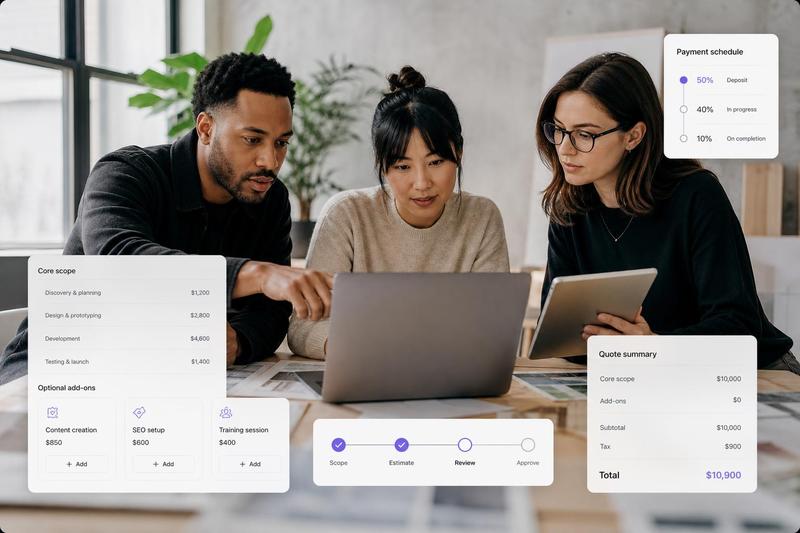

Service bundles can make a quote easier to approve, but only when the bundle is clear. If the client sees a vague “growth package” or “premium installation bundle” with one unexplained price, they may wonder what is actually included. If you hide too much detail internally, your team may miss costs, over-service the job, or discount away the margin that made the work worth taking.
A good service bundle quote does two things at the same time: it simplifies the buying decision for the client and keeps enough structure behind the scenes for you to price confidently. That means the quote should show the outcome, the core scope, the boundaries, the optional add-ons, and the payment terms without turning into a messy spreadsheet.
What is a service bundle quote?
A service bundle quote packages several related services into one offer. For example, a web design studio might quote a “launch bundle” that includes strategy, design, development, testing, and handover. A contractor might quote a bathroom refresh bundle that includes labor, standard materials, cleanup, and project management. A consultant might bundle an audit, workshop, roadmap, and follow-up call.
The concept is similar to the broader idea of bundle pricing: grouping products or services together into one combined offer. Salesforce describes bundle pricing as selling multiple items together, often with a combined price that is easier for customers to evaluate. For service businesses, the real benefit is not only the price. It is clarity, repeatability, and faster quoting.
When bundles make sense
Bundles work best when the services are commonly bought together, the delivery process is reasonably repeatable, and the client benefits from seeing one joined-up solution instead of a long menu of disconnected tasks. They are especially useful for agencies, consultants, designers, developers, contractors, and small studios that repeatedly quote similar work.
- Agencies: campaign setup, landing page, copy, reporting, and monthly optimization.
- Designers: brand identity, business card layout, social templates, and usage guide.
- Developers: discovery, build, testing, deployment, and training.
- Contractors: labor, standard materials, disposal, site protection, and handover.
- Consultants: audit, stakeholder interviews, strategy session, roadmap, and review call.
Bundles are less useful when every job is highly custom, unknowns are large, or the client needs to approve individual decisions separately. In those cases, a phased quote, discovery quote, or not-to-exceed structure may protect you better.
The margin problem with vague bundles
The risk with bundling is that it can make your own costs disappear. A client may only need to see one package price, but your business still needs to know what is inside that price: labor hours, subcontractor costs, admin time, materials, software, travel, revisions, and contingency. If those costs are not tracked, a bundle can look profitable when it is actually leaking margin.
Before sending a bundled quote, check the math the same way you would for individual line items. If the bundle includes five services, estimate the cost of each one, then add overhead, risk, and target margin. If you need a refresher, ququ’s guide to productized service quote templates shows how to package repeatable work while keeping scope, add-ons, exclusions, and pricing visible enough to manage.
A simple structure for service bundle quotes
The client-facing quote should be simple, but not empty. Use a structure like this:
- Bundle name: Use a plain name that describes the outcome, such as “Website Launch Bundle” or “Quarterly Content Setup.”
- Short summary: Explain what the bundle helps the client achieve in one or two sentences.
- Included scope: List the major deliverables or service components.
- Assumptions: State what you are relying on, such as client-provided content, site access, or standard materials.
- Exclusions: Clarify what is not included so the bundle does not expand silently.
- Optional add-ons: Show extras separately so the client can upgrade without blurring the base package.
- Payment schedule: Add deposit, milestone, or recurring payment terms.
- Approval wording: Make it clear what accepting the quote approves.
Example: agency service bundle
For a small marketing agency, the client-facing quote might look like this in plain language:
Campaign Launch Bundle
- Campaign planning session
- One landing page wireframe and copy draft
- Landing page design and build
- Basic conversion tracking setup
- Two rounds of revisions
- Launch checklist and handover notes
Optional add-ons: additional landing page variation, ad creative set, email sequence, monthly reporting dashboard.
Exclusions: paid media spend, CRM implementation, custom analytics development, more than two revision rounds, and third-party subscription costs.
This keeps the bundle easy to understand while still protecting the agency from common scope creep. The client sees one coherent launch offer, but the quote still defines the edges.
Example: contractor service bundle
A contractor might use a bundle for repeatable installation or refresh work:
Standard Room Refresh Bundle
- Site preparation and floor protection
- Minor wall repairs within agreed limits
- Primer and two coats of paint
- Standard trim touch-ups
- Cleanup and disposal of standard job waste
Assumptions: room is empty before work starts, existing surfaces are suitable for standard preparation, and no structural repairs are required.
Optional add-ons: premium paint upgrade, additional trim repair, weekend work, furniture moving, or extra rooms.
Notice that the bundle does not promise “everything needed.” It names the work, the assumptions, and the add-ons. That is what keeps a simple package from becoming an open-ended obligation.
How to show bundle value without creating confusion
You can show value without making the quote feel like a discount game. Instead of saying “normally $6,000, now $4,800” with no explanation, show the bundle logic in a cleaner way:
- Outcome: “Everything needed to prepare, launch, and hand over the campaign.”
- Convenience: “One coordinated scope instead of separate planning, copy, build, and launch quotes.”
- Efficiency: “Repeatable package based on our standard launch process.”
- Boundaries: “Includes two revision rounds; additional revisions quoted separately.”
The U.S. Chamber includes bundling among common pricing strategies for businesses, but the most important point for small service teams is this: a bundle should simplify the decision without weakening the scope. If a discount is included, make sure it is funded by real delivery efficiency, not hope.
Core bundle vs optional add-ons
The cleanest bundled quotes usually separate the core package from add-ons. The core bundle should solve the main client problem. Add-ons should be valuable but genuinely optional. This prevents the base price from ballooning and gives the client a way to increase scope intentionally.
For example, a designer’s brand starter bundle might include logo concepts, color palette, typography, and basic usage notes. Add-ons could include pitch deck design, social media templates, packaging mockups, or a brand voice guide. A developer’s website bundle might include five page templates, CMS setup, deployment, and training. Add-ons could include custom integrations, copywriting, SEO migration, or analytics dashboards.
If you want to present three bundles side by side, keep the differences obvious. ququ’s guide to good-better-best pricing explains how to offer options without making the client compare tiny differences across too many tiers.
Internal cost tracking: what the client does not need to see
Clients do not need to see every internal cost. They do need a quote that feels fair, specific, and professional. Your internal quote builder should still track the details behind the package so you can protect margin before exporting the client-ready version.
- Estimated labor hours by role
- Subcontractor or supplier costs
- Materials, subscriptions, or pass-through expenses
- Admin, meetings, project management, and handover time
- Revision allowance and risk reserve
- Target margin after discounts or package efficiencies
This is where a focused quoting tool helps. In ququ, you can create reusable products and templates for bundled services, include hidden internal costs, and automatically redistribute those costs into client-facing prices. The client sees a polished branded PDF, while your team keeps the cost logic needed to quote with confidence.
Client-ready wording you can reuse
Use wording that is plain, specific, and calm. Here are a few examples you can adapt:
Bundle summary wording
“This bundle includes the core services needed to complete the agreed project outcome as described below. It is designed as one coordinated scope so planning, delivery, review, and handover are managed together.”
Add-on wording
“Optional add-ons are not included in the base bundle price. They can be approved before work begins or quoted separately if requested later.”
Scope boundary wording
“Work outside the included scope, assumptions, or revision allowance will be quoted separately before it is started.”
Internal cost reminder
“This package price is based on the scope, assumptions, and delivery approach listed in this quote. Changes to timing, access, materials, or deliverables may affect the final quoted price.”
Pre-send checklist for bundled quotes
- Does the bundle name describe a clear outcome?
- Can the client understand what is included without a call?
- Are add-ons separated from the core bundle?
- Have you named the assumptions that affect delivery time or cost?
- Are exclusions specific enough to prevent scope creep?
- Have internal labor, materials, admin, and risk costs been checked?
- Does the payment schedule match the delivery risk?
- Is approval wording included?
- Can this bundle become a reusable template for future quotes?
Build bundles you can reuse
The best service bundles are not one-off inventions. They become reusable quote templates: a standard set of products, descriptions, assumptions, add-ons, internal costs, and terms that you can adjust for each client. That is how small teams quote faster without turning every opportunity into a blank document.
With ququ, you can build bundled quote templates once, reuse products across quotes, keep margin-sensitive costs hidden, export branded PDFs, and edit from mobile when a client needs a quick change. Start with one common service bundle, test it on your next quote, then refine the template as you learn which scope, add-ons, and wording lead to cleaner approvals.