IT support quotes are easy to underwrite and hard to fix later. A client asks for “monthly support,” “a few new laptops,” or “help with email and security,” and the quote quickly turns into a mix of users, devices, licenses, emergency support, onboarding time, and vague expectations. A good IT support quote template keeps that complexity readable without hiding the details that protect your margin.
This guide gives you a practical structure you can reuse for one-off support, onboarding projects, and monthly managed IT services. It is written for independent IT consultants, small MSPs, technical freelancers, and service teams that want cleaner client approvals without building every quote from scratch.
Start with the support model
Before you write line items, make the support model obvious. Clients often compare IT quotes poorly because one provider prices per user, another prices per device, and another bundles everything into a monthly plan. Your quote should name the model in plain language so the client understands what is included and what changes the price.
Common IT support quote models include:
- Break-fix support: hourly or block-based help for ad hoc issues, usually with no proactive monitoring.
- Per-user monthly support: a recurring price for each supported employee, often easiest for small office teams.
- Per-device monthly support: a recurring price for each workstation, server, network device, or endpoint.
- Flat monthly support plan: a fixed monthly fee for a defined environment and service level.
- Project-based setup: a one-time scope for onboarding, migrations, hardware rollout, security hardening, or network work.
External pricing guides are useful for checking whether your quote is in a realistic range, but your scope still matters more than the headline number. For example, AllSafe IT’s managed service provider pricing guide discusses common per-user ranges and pricing structures, while Cynet’s overview of managed IT service pricing models explains the tradeoffs between flat-rate, per-user, and per-device approaches. Use benchmarks like these as a sanity check, then quote based on your actual response commitments, security responsibilities, tooling, and support hours.
The core IT support quote template
Your quote does not need to be long, but it does need to be specific. A client-ready IT support quote should include these sections:
- Client and environment summary: business name, locations, number of users, devices, servers, core systems, and any known risks.
- Recommended support plan: the support model, coverage hours, included services, and monthly or one-off price.
- Line items: setup, onboarding, monitoring, helpdesk, endpoint support, network support, backup checks, security tasks, and optional add-ons.
- Service level agreement: response targets, priority levels, support channels, and after-hours rules.
- Exclusions: out-of-scope projects, hardware, software licenses, vendor charges, emergency work, compliance audits, and unsupported systems.
- Payment terms: deposit, monthly billing date, project milestones, late-payment terms, and renewal rules.
- Approval wording: clear acceptance language, quote expiry date, and next steps after approval.
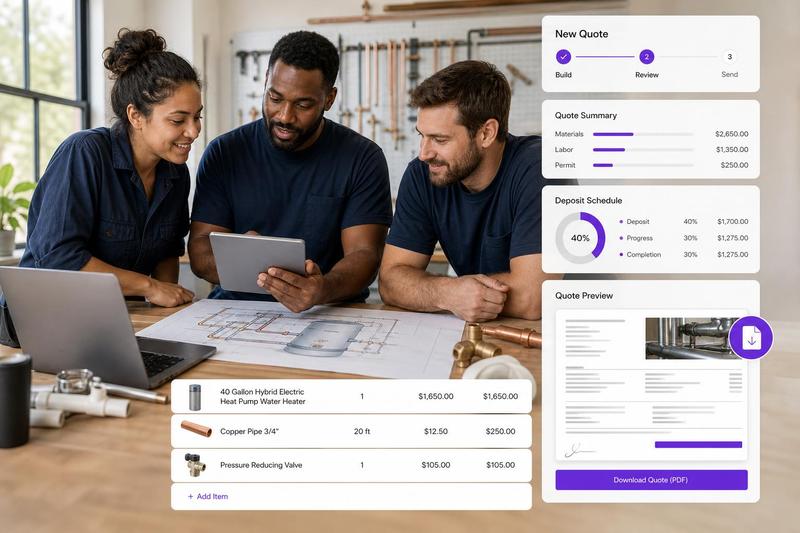
If you already use a reusable quote system, save these as sections rather than rewriting them. In ququ, for example, you can save common products like “Managed IT Support — Per User,” “New Device Setup,” “Firewall Configuration,” and “After-Hours Emergency Support,” then pull them into a branded quote PDF whenever a similar client asks for pricing.
Sample line items for an IT support quote
Line items should separate recurring support from setup work and optional extras. That keeps the quote easier to approve and makes margin easier to review before you send it.
One-time onboarding items
- IT environment audit and documentation
- User and device inventory
- Admin account review and access cleanup
- Endpoint security setup
- Backup verification and recovery check
- Email security baseline configuration
- Network and Wi-Fi review
- Initial monitoring tool deployment
Monthly support items
- Remote helpdesk support during business hours
- Endpoint monitoring and patch review
- User account administration
- Basic Microsoft 365 or Google Workspace support
- Backup status checks
- Monthly health summary
- Vendor liaison for approved systems
Optional add-ons
- After-hours support coverage
- Onsite visit allowance
- Advanced cybersecurity monitoring
- Security awareness training
- Quarterly strategy review
- Hardware procurement support
- Server maintenance
- Compliance documentation support
Do not bury expensive internal tasks inside vague bundles unless you have priced them properly. If you prefer not to show every internal cost to the client, ququ can keep internal costs hidden and automatically redistribute them into the client-facing line items, so the quote still looks clean while your margin stays visible to you.
Write SLA wording that clients can understand
An IT quote should not promise “fast support” without defining what fast means. Service level agreement wording protects both sides because it turns expectations into a practical support process. Keep it short enough to read, but clear enough to avoid arguments.
Sample SLA wording:
Support requests are handled Monday to Friday, 9:00am to 5:00pm, excluding public holidays. Critical issues affecting all users are targeted for initial response within 1 business hour. High-priority issues affecting one or more users are targeted for initial response within 4 business hours. Standard requests are targeted for response within 1 business day. Resolution times depend on issue complexity, client availability, vendor response times, and third-party systems.
That wording is better than a vague promise because it separates response from resolution. If you offer after-hours or emergency support, quote it separately and define the rate, minimum charge, and channel the client must use.
Include exclusions before the client needs them
Exclusions are not negative. They make the quote easier to trust because the client can see where the boundary sits. The goal is to avoid surprise invoices, not to sound defensive.
Useful IT support exclusions include:
- Hardware, software subscriptions, domain renewals, hosting, and third-party vendor fees unless listed as included.
- Major projects such as migrations, server replacements, new office setups, or compliance audits.
- Support for unsupported, end-of-life, or undocumented systems.
- Data recovery, incident response, ransomware remediation, or forensic investigation unless separately quoted.
- After-hours support unless included in the selected plan.
- Work caused by client changes made without prior review.
- Travel, parking, courier costs, or onsite expenses unless listed in the quote.
If your quotes often turn into ongoing monthly work, it is worth adapting ideas from a dedicated retainer quote template, especially around rollover rules, cancellation wording, and renewal terms. IT support has the same recurring-service risks: unclear boundaries, untracked extras, and clients assuming every future task is included.
Payment terms for IT support quotes
Payment terms should match the risk and timing of the work. For one-off setup projects, ask for a deposit before scheduling work and collect the balance at a clear milestone. For monthly support, bill in advance so you are not financing the client’s operations. For hardware or licenses, either require upfront payment or state that third-party costs are billed separately before purchase.
Example wording:
Monthly support is billed in advance on the first day of each month. One-time onboarding work requires a 50% deposit to schedule the project, with the remaining balance due on completion of the onboarding checklist. Hardware, software, licensing, travel, and third-party vendor costs are excluded unless listed in this quote and may require payment before purchase.
For technical service businesses, the structure is similar to software and implementation work: define the scope, list assumptions, show milestones where needed, and make change requests visible. If you quote implementation-heavy IT projects, compare your structure with this software development quote template for ideas on milestones, exclusions, and approval wording.
Example: small business managed IT quote
Here is a simple quote structure for a 15-person office that needs onboarding and monthly support:
- Environment audit and onboarding: one-time setup fee covering inventory, account review, documentation, endpoint setup, backup check, and monitoring deployment.
- Managed IT support: monthly per-user support for 15 users, including remote helpdesk, user account support, patch review, and backup status checks.
- Security baseline: optional add-on for email security hardening, MFA review, admin access cleanup, and security awareness session.
- Onsite allowance: optional half-day onsite visit per month, with additional onsite time billed at the stated hourly rate.
- After-hours emergency support: optional coverage with a minimum charge and separate emergency contact process.
This format gives the client choices without turning the quote into a menu of unrelated tasks. It also helps you protect margin because onboarding, recurring support, onsite work, and emergency support are priced as separate commitments.
Pre-send checklist
Before sending an IT support quote, check the following:
- Have you listed the number of users, devices, locations, and key systems the quote is based on?
- Does the client know whether pricing is per user, per device, flat monthly, hourly, or project-based?
- Are onboarding and recurring support separated?
- Are response targets clear without guaranteeing unrealistic resolution times?
- Are after-hours support, onsite visits, hardware, licenses, and vendor costs handled explicitly?
- Have you included assumptions and exclusions for legacy systems, unsupported software, and security incidents?
- Can the client approve the quote without asking what happens next?
- Have you checked your internal costs and margin before exporting the quote?
A reusable template makes this checklist easier to follow. With ququ, you can build an IT support quote once, save the service items you use most, adjust quantities from your phone during a client meeting, and export a branded PDF without rebuilding the layout each time. Start with the sections above, refine the wording after each approval, and turn your best IT support quote into a template you can trust.