
A budget range quote is useful when the client needs a realistic number, but the work is not defined tightly enough for a single fixed price. Used well, it helps both sides talk about tradeoffs before anyone pretends the scope is final. Used badly, it becomes a vague estimate that invites the client to remember only the low number.
The point is not to guess. The point is to show a responsible price window based on what you know today, then explain what would move the final quote up or down. That makes budget range quotes especially helpful for agencies, consultants, developers, designers, contractors, and studios that regularly price work before every detail is known.
When a budget range quote makes sense
Use a budget range when the client has enough information to discuss a real project, but not enough to approve a fixed scope. For example, a website redesign may depend on how many templates are needed, a renovation may depend on hidden site conditions, and a consulting project may depend on how many stakeholders need interviews.
A range is also useful when the client is still choosing the level of service. If they might want the basic implementation, a faster delivery option, or a more complete package, a range can keep the conversation practical before you build a detailed quote. If you have not already asked the right questions, start with a structured intake process like the one in pre-quote questions to ask before pricing client work.
When a range is risky
A budget range is risky when the client expects it to behave like a fixed quote. If your wording is loose, the low end can become an accidental promise. Avoid ranges when the work is already clear enough for a firm price, when procurement requires a fixed number, or when a client is mainly shopping for the cheapest possible answer.
It is also risky to use a range when you have not calculated your minimum profitable price. External pricing guidance usually starts with the same foundation: understand your costs before you present a price. The U.S. Chamber guide to pricing services emphasizes knowing costs, market position, and pricing model before setting service prices, while Gusto’s service pricing guide explains how baseline costs and overhead contribute to profitable pricing.
The simple budget range formula
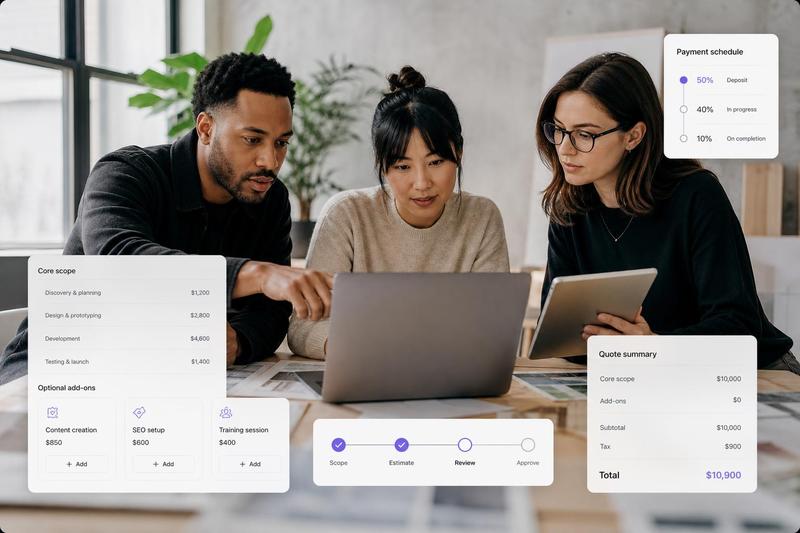
A useful range has four parts: a floor, a likely middle, a ceiling, and the assumptions that connect them. The floor is the lowest version you can deliver without damaging margin. The likely middle is the realistic version you would recommend. The ceiling is the sensible upper bound if the client wants more complexity, speed, access, or responsibility included.
1. Set the floor
Your floor should include labor, materials, subcontractors, software, travel, admin, project management, overhead, and target margin. Do not build the low end from optimistic delivery time. Build it from the smallest responsible version of the work.
- Agency example: A small landing page campaign may start at $3,500 if it uses one page, supplied copy, and two review rounds.
- Contractor example: A repair job may start at $1,200 if access is clear, materials are standard, and no hidden issues appear.
- Consultant example: A strategy review may start at $2,000 if it includes one workshop, one report, and no implementation support.
2. Build the likely middle
The middle is not a mathematical average. It is the version you think the client is most likely to approve once the scope is properly shaped. This is where you include normal review time, communication, setup, expected complexity, and the level of quality you actually want to deliver.
Ququ is useful here because you can save common services as reusable products, then assemble the likely version quickly instead of rebuilding the math from scratch. If you have internal costs you do not want to show as separate client line items, ququ can keep those hidden and redistribute them automatically across visible items so the quote still protects margin.
3. Define the ceiling
The ceiling should describe the conditions that push the quote higher. These might include more pages, extra rooms, faster turnaround, complex integrations, premium materials, more stakeholder interviews, additional revisions, or weekend work. A ceiling is not a scare tactic. It is a boundary for the most complex version you can reasonably foresee.
How to word a budget range clearly
Your wording should make three things obvious: the range is based on current information, the final price depends on confirmed scope, and the client will approve the final quote before work starts.
Copyable wording
Based on the information available today, we expect this work to sit in the range of $6,000 to $9,500. The lower end assumes the core scope described below, supplied content, and two review rounds. The upper end allows for additional templates, expanded stakeholder review, and more detailed implementation support. Before any work begins, we will confirm the final scope and send a fixed quote for approval.
Shorter wording
This budget range is provided for planning purposes. Final pricing will depend on confirmed scope, timing, materials, and approvals. We will not begin paid work until you approve the final quote.
Use ranges to guide choices, not hide uncertainty
A strong budget range should help the client make a better decision. One practical method is to show three scope paths: lean, recommended, and expanded. This works because the client can see what changes between price points instead of negotiating blindly.
- Lean: The smallest useful version, with tight scope and fewer options.
- Recommended: The version you would confidently deliver for the client’s goal.
- Expanded: A higher-involvement version with more speed, support, access, or complexity included.
This is closely related to ethical anchoring. If you want to make your recommended option easier to understand without pressuring the client, use the principles in price anchoring in client quotes: show meaningful differences, recommend one path, and explain the tradeoff in plain language.
A budget range worksheet
Use this worksheet before sending a range. It keeps the number connected to real scope instead of instinct.
- Define the outcome: What is the client actually trying to achieve?
- List the known scope: What is included based on today’s information?
- List the unknowns: What could change after discovery, site review, or stakeholder input?
- Calculate the floor: What is the lowest responsible price after labor, costs, overhead, and margin?
- Set the likely version: What version would you recommend if the client wants a solid result?
- Set the ceiling: What realistic additions could push the project upward?
- Name the triggers: What exactly moves the price from low to middle or middle to high?
- Confirm approval: How will the client approve the final fixed quote?
Examples by service business type
Creative studio
Brand refresh budget range: $4,500 to $8,000. Lower end includes logo refinement, color palette, typography, and one-page usage guide. Upper end includes expanded brand applications, extra review rounds, and launch asset preparation.
Developer or technical consultant
Automation setup budget range: $3,000 to $7,500. Lower end assumes one workflow, standard integrations, and supplied access. Upper end allows for multiple workflows, custom edge cases, testing documentation, and team handoff.
Contractor
Small renovation budget range: $8,000 to $13,500. Lower end assumes standard materials, clear access, and no hidden structural issues. Upper end allows for premium fixtures, additional prep, and minor unforeseen site conditions.
Pre-send checklist
- Does the low end still protect margin?
- Does the high end represent realistic complexity, not a random cushion?
- Have you stated the assumptions behind the range?
- Have you named what moves the price up or down?
- Have you made it clear that the final quote requires approval?
- Have you avoided showing internal costs that invite unnecessary negotiation?
- Can the client understand the range in one scan?
In ququ, you can turn this into a reusable quote template: one section for the budget range, one for assumptions, one for optional paths, and one for final approval wording. You can reuse products across quotes, hide internal cost details when needed, export a branded PDF, and adjust the range from your phone before a client meeting. That is the practical advantage of a focused quoting tool: fewer copied documents, cleaner pricing logic, and a quote that looks ready to approve.
The bottom line
Budget range quotes work when they are specific. Do not send a loose number and hope the client understands the uncertainty. Send a range with a floor, a likely version, a ceiling, and plain-language assumptions. That gives the client enough confidence to keep moving while protecting you from underpricing flexible work.