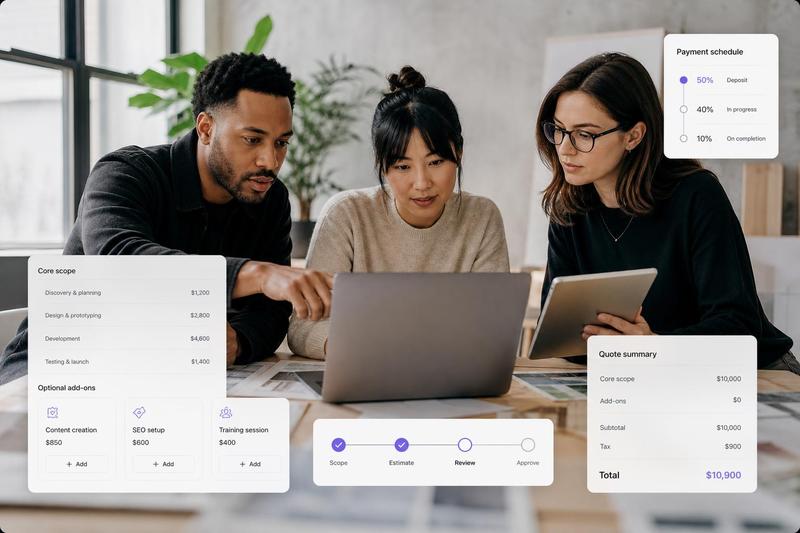

Discounts can help you win the right work, but they can also quietly train clients to question every price you send. For agencies, consultants, designers, developers, contractors, and small studios, the goal is not to avoid discounts forever. The goal is to show them in a way that protects your margin, preserves the value of the work, and makes the tradeoff clear.
The worst discount is the one added at the end because the client asked, “Can you do it for less?” That kind of discount usually has no condition, no scope change, and no margin check. Before you reduce a number, make sure you understand the difference between markup and margin; this is where many quotes become unprofitable without looking obviously wrong. If you need a refresher, start with profit margin vs markup before changing the client-facing price.
Start with the rule: discounts need a reason
A discount should never look like you guessed high and then backed down. It should be tied to a business reason the client can understand. Good reasons include upfront payment, reduced scope, flexible scheduling, a bundled package, a shorter approval deadline, or a strategic first project with a clear boundary. Pricing experts often recommend using value-based selling and disciplined discounting rather than default concessions; this discount pricing guidance from Simon-Kucher is a useful reminder that discounts work best when they support a deliberate commercial goal.
For example, “10% off because you asked” weakens your position. “10% discount applied for full payment upfront” is clearer and safer. “Reduced project package excluding the brand guidelines workshop” is even better because it protects the price of the original scope while giving the client a lower-cost route.
Calculate the discount before you show it
Before adding any discount line, calculate the original price, direct costs, internal time, risk buffer, and target margin. Then test the discounted price against your minimum acceptable profit. A small discount on a high-margin strategy session might be harmless. The same percentage on a contractor quote with materials, subcontractors, and travel can erase most of the profit.
Use this simple sequence:
- Original quote price: the amount you would charge without a discount.
- Known costs: materials, subcontractors, software, licensing, travel, printing, or other direct expenses.
- Internal labor cost: the real cost of your team’s time, not only the hourly rate you show the client.
- Risk allowance: a buffer for uncertainty, rework, coordination, or site conditions.
- Discount condition: what the client must do or accept to receive the lower price.
- Final margin: the profit left after the discount is applied.
This is one reason ququ’s hidden internal costs are useful. You can keep your real costs private, redistribute hidden costs automatically into visible quote items, and still export a clean branded PDF that shows the client only what they need to approve.
Show the discount as a conditional line item
When the discount is legitimate, show it as a separate line so the client sees the value you are giving. Do not silently reduce every line item unless you want the lower price to become the new normal. A clear discount line keeps the original value anchored while explaining why the final total changed.
Sample wording:
- Early approval discount: Applied if the quote is accepted by Friday, 12 June.
- Upfront payment discount: Applied when the full project fee is paid before kickoff.
- Reduced scope adjustment: Applied after removing the competitor research workshop and second design concept.
- Flexible scheduling discount: Applied because the work can be scheduled around existing project capacity.
The key is to avoid making your margin part of the conversation. Clients need clarity about scope, price, timing, and terms; they do not need your internal economics. For more on that boundary, read what clients actually need to see in a quote.
Use scope tradeoffs before price cuts
If a client says the quote is too expensive, the first move should usually be scope adjustment, not discounting. Ask what outcome matters most, then remove or defer the lower-priority parts. A web designer might remove a custom illustration package. A consultant might reduce stakeholder interviews. A contractor might switch from premium fixtures to standard fixtures. A developer might move advanced reporting to a phase two quote.
This preserves the logic of your pricing: less work costs less, but the same work does not magically become cheaper. It also helps the client make a better decision because they can see what they are trading away.
Offer packages instead of one discounted option
Packages are often more effective than a single quote with a discount. A good-better-best structure gives the client choice without forcing you to negotiate from one number. The basic option can reduce scope, the standard option can match the recommended approach, and the premium option can include faster delivery, extra support, or deeper strategy. Service businesses commonly use value-based, bundled, and tiered pricing strategies, and this overview of pricing strategies for service-based businesses explains why different models suit different client situations.
In ququ, you can build reusable products and quote templates for each package, then adjust quantities, hide internal cost details, and send a branded PDF from the same workflow. That makes it easier to present options without rebuilding every quote from scratch.
Discount examples for common service quotes
Agency project
A branding agency quotes $8,000 for strategy, identity design, launch assets, and brand guidelines. The client asks for a lower price. Instead of applying a blanket 15% discount, the agency removes one workshop and reduces the launch asset set. The quote shows a “reduced scope adjustment” and keeps the original full-service package visible as the recommended option.
Consulting engagement
A consultant quotes $4,500 for an audit and implementation plan. The client can pay upfront and provide all required data before kickoff. The consultant applies a 5% upfront payment discount because the condition improves cash flow and reduces admin risk.
Contractor job
A contractor quotes $12,000 for a renovation with materials and subcontractor costs. A 10% discount would hurt margin because costs are high. Instead, the contractor offers a lower-cost materials option and a flexible scheduling discount for non-urgent work.
Freelance design or development
A freelancer quotes $2,200 for a landing page. The client wants to spend $1,800. The freelancer removes custom animation and advanced copy revisions, then lists the lower total as a scoped-down option rather than discounting the original work.
Quote-discount checklist
Before you send a discounted quote, check the following:
- Have you calculated the final margin after the discount?
- Is the discount tied to a clear condition or scope tradeoff?
- Does the quote still show the value of the original work?
- Have you avoided exposing internal costs the client does not need?
- Are payment terms, approval deadline, and discount conditions written clearly?
- Would you be comfortable offering the same discount again under the same condition?
- Have you saved the structure as a reusable template for future quotes?
A better way to write the discount line
Use plain language. Avoid apologetic phrases like “special deal,” “just this once,” or “we can knock off.” Try wording like this:
Early approval adjustment: A 5% discount has been applied because this quote is approved by 5:00 p.m. on 12 June and the project can be scheduled into our current production window.
Scope reduction adjustment: This option removes the second concept round and launch asset pack from the recommended quote. These items can be quoted separately later if required.
Upfront payment adjustment: A 5% discount has been applied for full payment before project kickoff. If standard staged payments are preferred, the original quoted total applies.
Keep the discount professional
A well-presented discount should make the quote easier to approve, not make your pricing look flexible in the wrong way. Keep the reason visible, the condition specific, and the original value intact. When you build quotes in ququ, you can save these discount structures inside reusable templates, keep internal costs hidden, and send a clean branded PDF that feels professional instead of negotiated in a panic.
The simple rule: discount only when the tradeoff is clear, the margin still works, and the quote teaches the client how your pricing decisions are made.