
International clients can be great for a small service business, but currency changes can quietly turn a good quote into a thin-margin job. The problem is rarely the client. The problem is usually an unclear quote: no stated currency, no exchange-rate assumption, no expiry date, no tax note, and no rule for what happens if the payment arrives weeks later at a different rate.
The fix is not to make your quote sound like a legal contract. It is to make a few practical choices before you send it: which currency you will quote in, how long the price is valid, how taxes are handled, and who carries the risk if the exchange rate moves. Put those choices into a reusable template once, then use it every time you quote outside your home market.
Start by choosing the quoting currency
You usually have three options. You can quote in your own currency, quote in the client’s currency, or show both. Quoting in your own currency protects you from exchange-rate movement, but it may push uncertainty onto the client. Quoting in the client’s currency can feel easier for the buyer, but you need to protect your margin if the rate changes before payment. Showing both can work well for higher-value projects, especially when the client needs an internal approval in their local currency.
For most agencies, consultants, developers, designers, and contractors, the practical rule is simple: quote in the currency you expect to be paid in. If the client will pay you in USD, quote in USD. If they insist on paying in EUR, GBP, CAD, or AUD, make sure your price includes enough buffer for fees, conversion costs, and short-term currency movement.
Build exchange-rate assumptions into the quote
A weak international quote says, “Total: 8,000.” A stronger one says, “Total: USD 8,000, valid until 15 August 2026.” A better one adds a clear exchange-rate note if another currency is involved. You do not need a complicated finance clause. You need a sentence that explains which rate was used and what happens if the rate changes materially.
Use wording like this: Prices are quoted in USD. If payment is made in another currency, the final amount will be converted using the exchange rate available from our payment provider on the payment date. Bank fees, card fees, and foreign exchange charges are the client’s responsibility unless agreed otherwise in writing.
If you prefer to lock the rate at the quote date, say that instead: This quote uses an exchange rate of 1 USD = 0.92 EUR as of 28 July 2026. If the quote is accepted after the validity date, pricing may be revised to reflect updated exchange rates, supplier costs, or payment fees.
Shorten the validity period for currency-sensitive quotes
Currency risk grows with time. A quote that is safe for seven days may be risky for sixty days. For local work, a 14-day or 30-day validity period can be fine. For international work, especially projects with subcontractors, software licenses, imported materials, or travel costs, consider a shorter window.
A practical starting point is:
- 7 days for quotes heavily affected by exchange rates, material costs, or travel.
- 14 days for most international service projects.
- 30 days only when your costs are stable and your margin can absorb movement.
If you already use quote expiry wording, adapt it for international work. The goal is not to pressure the buyer. It is to make sure you are not held to an old price after the cost base has changed. For broader expiry language, see this guide to quote conditions that prevent misunderstandings.
Do not forget payment fees and conversion costs
Many small teams price the work correctly and still lose margin when the payment lands. International card fees, wire fees, payment platform charges, intermediary bank deductions, and currency conversion spreads can add up quickly. If your quote does not mention them, the client may assume they are included.
There are two clean ways to handle this. First, build likely fees into your price as an internal cost. This keeps the quote simple for the client. Second, state that bank, transfer, and conversion fees are payable by the client. This is clearer, but it can feel less polished if it appears as a surprise at the end.
Ququ is useful here because you can keep internal costs inside reusable quote items and redistribute them automatically into client-facing prices. That lets you account for FX buffers, payment fees, or admin time without cluttering the quote with every internal calculation.
Make taxes and VAT clear before the client approves
International quotes can get messy when tax is left vague. You may need to show tax in your local currency for reporting, charge VAT or sales tax depending on the type of client and location, or mark the quote as tax-exclusive when the final treatment depends on the buyer’s details. The safest move is to avoid guessing in the quote.
Use plain wording such as: Prices exclude any applicable VAT, sales tax, withholding tax, customs duties, or local charges unless shown as a separate line item. Final tax treatment may depend on the client’s billing country, tax registration status, and the services supplied.
Official guidance varies by country. The IRS guidance on foreign currency and exchange rates explains that U.S. tax reporting generally requires foreign-currency amounts to be translated into U.S. dollars using the relevant exchange rate when the item is received, paid, or accrued. UK businesses should also review HMRC guidance on foreign-currency transactions and VAT, which explains that foreign-currency sales must be converted into sterling for VAT purposes. For client-facing quote layout, this guide on showing sales tax or VAT on a quote is a useful next step.
Use deposits to reduce exchange-rate exposure
The longer you wait to collect payment, the more currency risk you carry. Deposits, milestone payments, and shorter payment terms reduce that risk because less money is left exposed until the end of the project. They also help cash flow, which matters when international transfers take longer or require extra admin.
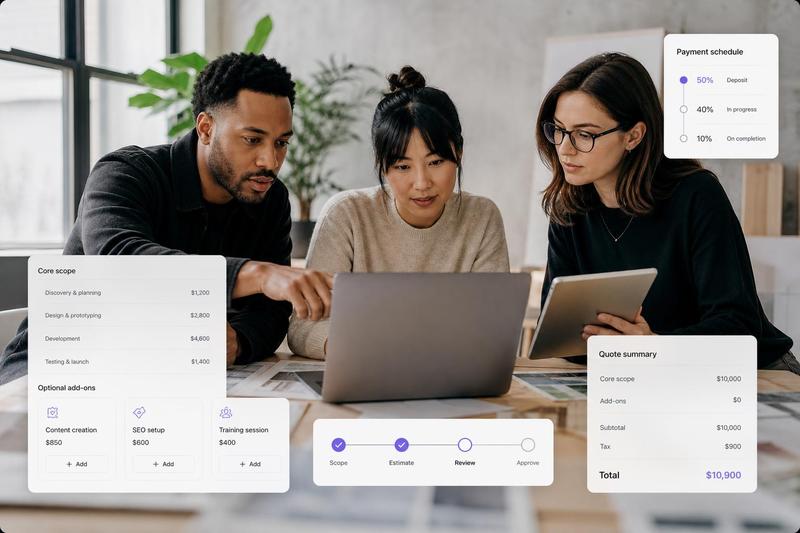
For example, a website studio quoting a client overseas might use 40% upfront, 40% after design approval, and 20% before launch. A consultant might use 50% upfront and 50% before final delivery. A contractor dealing with imported materials might require the materials portion upfront, with labor billed by milestone.
Keep the wording direct: Work begins after receipt of the initial deposit. International transfer fees and currency conversion charges are not deducted from the quoted project total. Any shortfall caused by bank charges must be settled before delivery of final work. For more examples, use this guide to payment terms on client quotes.
Create a reusable international quote template
Do not rewrite these terms from scratch every time. Create one international quote template with the fields you need, then duplicate it for each new client. The template should include:
- Quote currency and payment currency.
- Exchange-rate source or conversion method.
- Quote validity date.
- Deposit or milestone payment schedule.
- Bank fee and payment platform fee wording.
- Tax or VAT assumptions.
- What happens if the client accepts after the expiry date.
In ququ, you can turn that structure into a reusable template, add standard quote items from your product library, keep internal buffers hidden from the client, and export a clean branded PDF. That gives the client a professional quote while your team keeps the margin logic behind the scenes.
Quick checklist before sending
- Is the currency clearly shown next to every total?
- Does the quote say which currency the client must pay in?
- Have you included payment fees, bank charges, or conversion costs in the price?
- Is the quote validity period short enough for the currency risk?
- Are deposits or milestones used to reduce exposure?
- Is tax shown clearly or explained as excluded/pending final treatment?
- Does the approval wording say what happens if payment arrives short because of fees?
International quoting does not need to be complicated. It just needs to be explicit. State the currency, state the timing, protect the payment terms, and keep the wording reusable. That way, you can work with clients across borders without letting exchange rates quietly eat the profit from a well-priced job.